
Complete Guide to Timeshare Cancellation Letters & Timeshare Rescission Letters
The timeshare sales pitch is a dream vacation come true due to the lifetime holidays, well-maintained resorts, unlimited flexibility, and modest ownership expenses. But what most owners find is the opposite: rising maintenance fees, special assessments, vaporized availability, pressure sales tactics, and a contract that has miraculously become impossible to terminate.
Statistics from the American Resort Development Association (ARDA) show that while the industry is worth billions, approximately 85% of buyers eventually regret their purchase, primarily due to these escalating costs.
This is where it becomes important to have a Timeshare Cancellation Letter or Timeshare Rescission Letter. It doesn’t matter if you’re in the legal cool-down period or decades outside it; if you take the right approach, you can find a legally sound way of breaking up with your timeshare resort.
Recent industry data reveals that while only 15% of buyers successfully utilize their rescission rights, those who do can save an average of $24,000 in purchase costs and tens of thousands in future maintenance fees.
This guide covers everything you should know, such as the timeshare cancellation laws, deadlines, and letter templates, with further details on cancellation post-rescission period.
What is a Timeshare Cancellation Letter?
A Timeshare Cancellation Letter (or “timeshare exit letter”) is the formal written notice to the resort or developer that you wish to end your contract. Its purpose is simple: to notify the company of your cancellation, rescission, or termination of a contractual obligation under the timeshare.
It has two applications:
- During the legal timeshare rescission time (the cooling-off period).
- Once the rescission period has passed (formal cancellation of contract).
The content and approach are different for each category, but the goal remains the same: total legal release from financial liability.
Here is the Timeshare Cancellation Letter:
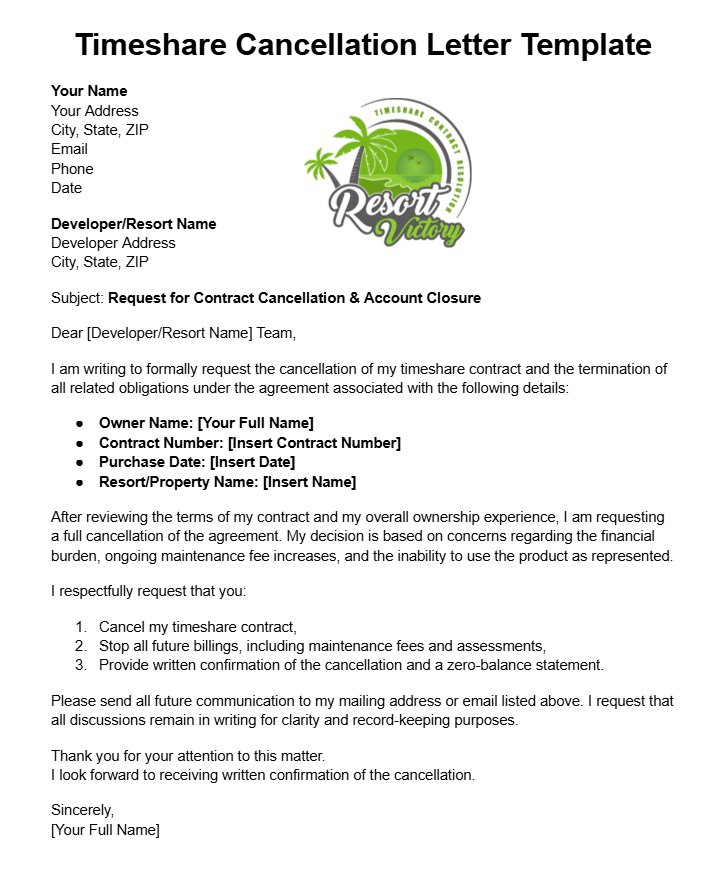
What Is a Timeshare Rescission?
A timeshare rescission letter is used when there is a cooling-off period, which means you can cancel the timeshare contract easily and receive a full refund. The time frame varies with differences from state to state. In 2026, these laws remain the strongest protection for consumers, yet nearly 95% of buyers wait until after this window closes to seek more information about their true maintenance costs.
A rescission period exists in each state, usually:
- 3–7 days in most U.S. states.
- In some countries, up to 10–14 days.
- The time runs from the date of signing or the date you receive the public offering statement.
When done correctly and in a timely manner, sending a timeshare rescission letter is the quickest and easiest way to cancel.
Knowing the Rescission Period (Cooling-Off Laws)
Timeshare sales presentations are well known for being overly long, manipulative, and high-pressure. Cooling-off periods were created by lawmakers in order to protect consumers who have been deceived or rushed.
Important details:
- The rescission deadline is strict. The resort can refuse your request if you miss it by only one day.
- You need to mail the letter within that window.
- The letter typically must be sent by certified or registered mail, and not by email or delivered in person, in most states.
If you’re still within your state’s rescission period, all you need is a simple letter. If not, you cross the threshold into complex timeshare cancellation.
State Timeshare Rescission Periods
Below are examples of timeshare rescission periods by state as of 2026:
- Florida: 10 days
- California: 7 days
- Nevada: 5 days
- Colorado: 5 days
- South Carolina: 5 days
- Hawaii: 7 days
These timeframes are subject to change, so be sure to refer to your contract. It’s legally required to include your specific rescission period and instructions for cancellatiom.
What if the Rescission Period is Over?
This is the position that most owners are in. Upon expiration of the rescission period, automatic cancellation by the resort is no longer mandatory. But there are still options, and a clear timeshare cancellation letter can pave the way. With average maintenance fees reaching $1,650 annually in 2026, a 36% increase over the last five years waiting to act only compounds the financial burden.
Timeshare companies seldom cut their owners loose easily. To cancel a contract after the window, it is generally not so simple and will need:
- Detailed evidence of misrepresentation.
- Contract review and identifying “material errors.”
- Escalation to Compliance or Developer Relations.
- Negotiation and legal pressure.
- Professional exit representation.
And that’s exactly where Resort Victory can be a tremendous help to most owners. Because as a licensed and bonded timeshare exit team, they take care of the negotiation, paperwork, and pressure to cancel your contract.
How to Write a Timeshare Rescission Letter (During the Cooling-Off Period)
If you’re within the statute of limitations, keep it short and straightforward. Do not include cries or complaints, pleas, reasons, or excuses. Those can complicate the process.
What to include:
- Full name(s) on the contract.
- Contract number and unit/week number.
- Purchase date and Resort name.
- A clear statement: “I am exercising my legal right to rescind this contract.”
- Request for a full refund of all payments made.
- Signature(s) of all owners.
Key tip: Follow the instructions of your contract to the letter. A section titled “Notice of Cancellation” or “Right to Rescind” is included in nearly all timeshare resorts. Use the address detailed there (never send off to the general customer service office).
How to Write a Timeshare Cancellation Letter (After Rescission Period)
The content of your letter needs to change when you turn up the heat after the cooling-off period ends. It is not just that you want to end the timeshare contract, but also because of factors like:
- Misrepresentation or omission of material facts.
- Failure to disclose total costs or “special assessments.”
- Pressure or deceptive sales tactics.
- Financial hardship, disability, or inability to travel.
What to include in your timeshare cancellation letter?
- Specifics of the contract (names, date, and number).
- A simple and blatant statement that you want to end the contract.
- Particular falsehoods or sales practices you experienced.
- Copies of relevant documents and evidence.
- A definitive deadline for the resort to reply.
Developers frequently ignore requests because maintenance fees represent guaranteed revenue. In 2026, research shows that some resorts are seeing maintenance fee hikes as high as 13%, far exceeding the national inflation rate. It is for this reason that most owners team up with Resort Victory to negotiate in their favor.
Tips for Writing an Effective Timeshare Cancellation Letter
Writing a clear and professional cancellation letter is one of the most important steps in ending your timeshare agreement. A well-structured letter helps you protect your rights and avoid delays from the resort.
- Gather All Contract Information: Accurate information helps the resort identify your account quickly. Before drafting your timeshare rescission letter, collect essential documents such as your membership number and purchase date.
- Be Clear, Direct, and Formal: State your intention in the first sentence. Avoid emotional explanations. If you are within your state’s rescission period, reference the applicable law.
- Request Written Confirmation: Ask the resort to provide a written acknowledgment of your cancellation.
- Send the Letter with Trackable Mail: Use certified mail or another delivery method that provides proof of receipt. Keep copies of the letter and tracking information.
- Seek Professional Support When Needed: If you are outside the rescission period, a professional exit team like Resort Victory can help guide you through a legitimate release.
Why Timeshare Companies Resist Cancellations?
Knowing the resort’s motives makes the challenge easier to comprehend:
- Maintenance fees are guaranteed revenue: Your annual fees support the operations of the resort.
- Asset Liability: Once an owner is gone, the responsibility returns to the developer.
- The Chain Reaction: If they release you, thousands of other owners may do so, too.
How Resort Victory Aids Timeshare Owners in Cancelling Their Purchases?
The majority of timeshare cancellations after that rescission period involve industry skill and strategy that the average owner simply lacks. Resort Victory assists by:
- Reviewing your contract in detail for legal loopholes.
- Identifying misrepresentations used during the sales pitch.
- Creating a strategic exit plan and negotiating release terms.
- Liaising with the resort on your behalf and protecting you from scams.
For a lot of owners, DIY cancellation efforts go nowhere. When you have a team working for you, your success greatly increases, and the resort stays accountable.
Key Sections of a Good Cancellation Letter
Rescission or cancellation, there are five key components to a winning letter:
- Clear and direct intention: Make the simple declaration that you wish to rescind or terminate.
- Accurate contract details: Mistakes provide the opportunity to reject your request.
- Documentation: Include photocopies of contract pages or receipts.
- Certified mailing: Always use tracking. Never, never e-mail unless the contract states you may.
- Persistence: Resorts are trained to delay. Your letter starts the process, but you must keep going until the contract is signed off.
When Not to Write the Letter Yourself?
DIY cancellation may not be good if:
- You have had the timeshare for quite some time.
- You were heavily misled or are facing aggressive collection threats.
- Your resort is known for disputes or you have points-based programs.
- You’re inundated or not sure where to begin.
In such cases, you will need a professional to get things done right. The Resort Victory team is an expert in long-term cancellations and second-hand contracts.
Your timeshare is not ‘forever’ and does not have to be! The terms are sold as actual, ongoing obligations, though they don’t have to be. Whether you are within the timeshare rescission window or many years outside of it, you have rights, options, and tools to get out legally.