
How to Cancel Your Silverleaf Timeshare

To achieve a successful Silverleaf timeshare cancellation, you must either submit a formal rescission letter within your state’s statutory “cooling-off” period (typically 3–15 days) or negotiate a deed-back directly with the developer, Holiday Inn Club Vacations, provided your account is in good standing.
If you are past the rescission window, the most effective way to cancel Silverleaf timeshare contracts involves hiring a specialized exit firm to navigate the legal complexities of your specific agreement.
The Landscape of Silverleaf Resorts Timeshare
Originally a privately held company based in Texas, Silverleaf Resorts timeshare was acquired in 2015 by Orange Lake Resorts, the operator of Holiday Inn Club Vacations. This merger shifted many owners from a deeded-week system to a points-based model, leading to reported increases in annual costs. Today, Silverleaf timeshares are located across the United States, with a heavy concentration in the South and Midwest. Key locations include:
- Texas: Hill Country Resort (Canyon Lake), Holly Lake Ranch, Piney Shores Resort (Conroe), and Galveston Seaside Resort.
- Missouri: Holiday Hills and Ozark Mountain Resort in Branson.
- Other States: Oak n’ Spruce Resort (Massachusetts), Apple Mountain Resort (Georgia), and Fox River Resort (Illinois).
How to Cancel Your Silverleaf Timeshare: Primary Methods
When learning how to cancel your Silverleaf timeshare, you must first identify where you stand in the ownership timeline.
1. Rescission: The Grace Period
If you just purchased, you have a legal right to a Silverleaf timeshare cancellation without penalty. Every state has a “cooling-off” period. For example, Texas law generally allows 6 days to rescind. You must send a certified letter to the address listed in your contract before this window closes.
2. The Deed-Back Program
A “deed-back” is the process of returning your property to the resort. To successfully cancel silverleaf timeshare via this route, your maintenance fees must be current and the mortgage must be paid in full. While not guaranteed, the developer may accept a “surrender” to avoid the costs of a future foreclosure.
3. Professional Silverleaf Timeshare Exit
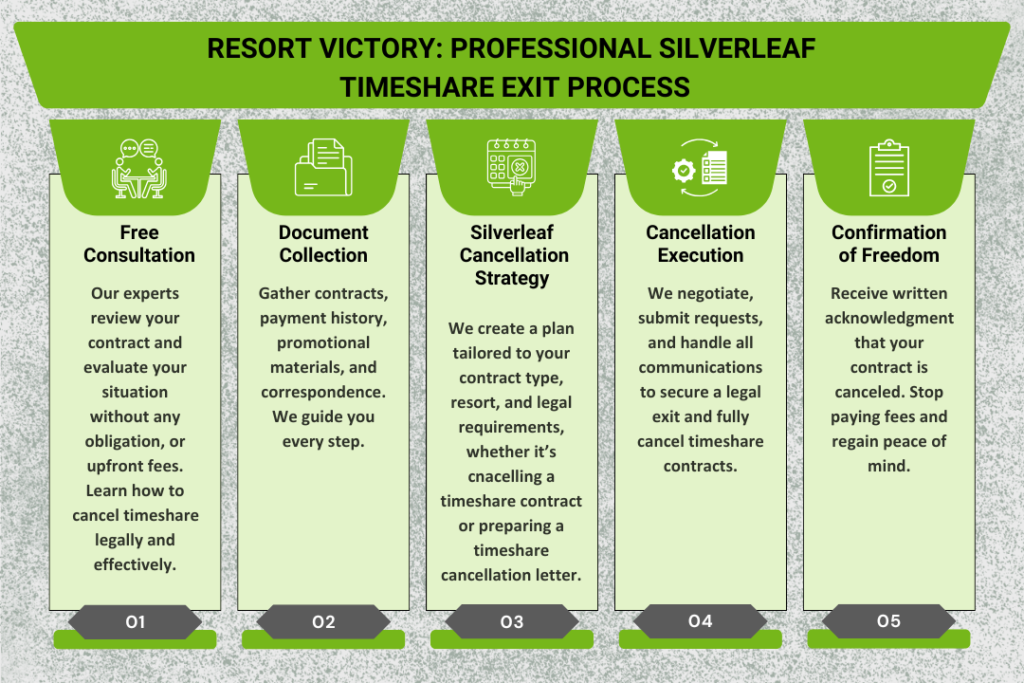
For many, the only way how to get out of silverleaf timeshare is by hiring professional help. A Silverleaf timeshare exit team or attorney focuses on identifying misrepresentations made during the sales presentation to pressure the resort into a release.
Costs, Timelines, and Financial Facts
Understanding the “why” behind an exit often comes down to the math. In 2026, the average silverleaf timeshare purchase price hovers around $22,000, but the “hidden” costs are the true burden:
- Maintenance Fees: Averaging $1,200–$1,500 annually, these fees often increase by 5% each year.
- Special Assessments: Unexpected bills for resort renovations can range from $500 to $2,500.
- Cancellation Costs: Hiring a professional team can cost between $3,000 and $10,000, depending on the complexity of the case.
- Timeline: A legal cancellation typically takes 6 to 18 months.
Selling, Renting, and the Resale Market
Many owners ask how to sell Silverleaf timeshare properties to recoup their investment. Unfortunately, the resale market is notoriously difficult. If you look for a Silverleaf timeshare for sale on sites like eBay or TUG, you will often find them listed for as little as $1.00 because the “value” is swallowed by the perpetual maintenance fees.
While you can list your Silverleaf timeshare for sale, success rates are low. Some owners attempt to rent silverleaf timeshare intervals to cover the annual dues, but high “guest certificate” fees and internal booking restrictions often make this a break-even venture at best.
If you are looking to buy Silverleaf timeshare points, the secondary market is significantly cheaper than buying from the developer, but the long-term financial obligations remain the same.
Deconstructing the Silverleaf Contract and Hidden Loopholes
The architecture of a Silverleaf resorts timeshare contract is built on the concept of “perpetuity,” a legal term meaning the obligation lasts for the life of the owner and technically becomes a liability for their estate. However, within these dense documents lie potential loopholes often exploited by consumer protection attorneys. One common vulnerability is the “availability clause.”
If a resort consistently fails to provide the promised inventory while continuing to sell new points to the public, it may be in breach of its own fiduciary duty. Furthermore, many older Silverleaf contracts were “deeded,” meaning they are treated as real estate. If the developer failed to properly record the deed or if the legal description of the property is inaccurate, the entire contract may be voidable under state property laws.
The Reality of Ownership Transfers and Successor Liability
One of the most frightening aspects of silverleaf timeshares is the “heirs and assigns” clause. This provision is designed to ensure that even after the original owner passes away, the resort can continue to collect maintenance fees from the family. This creates a cycle of generational debt that many families find impossible to break without professional intervention.
To stop this, owners often seek to how to get rid of silverleaf timeshare obligations before they become an inheritance issue. Legal experts suggest that if a contract was signed under duress—such as during an eight-hour sales presentation where food or exit was restricted—the “meeting of the minds” required for a valid contract never actually occurred, providing a powerful lever for cancellation.
Risks of Resale and Exit Scams
As owners become desperate to find a silverleaf timeshare for sale to any willing buyer, they often fall prey to sophisticated exit scams. These fraudulent entities frequently use cold calls, claiming they have a “corporate buyer” ready to pay $25,000 for a property that is actually worth zero.
They will then demand an upfront “transfer tax” or “escrow fee” of several thousand dollars. Once the money is wired, the company disappears. It is a statistical fact that over 90% of timeshare resale offers that require an upfront fee are fraudulent.
Legitimate companies like Resort Victory, by contrast, work on a performance-based model or provide clear legal representation with a verifiable physical office and a history of successful case resolutions.
Misrepresentation in Contract Termination
A significant percentage of silverleaf timeshare cancellation cases are built on the foundation of verbal misrepresentation. Sales agents often tell potential buyers that their timeshare is a “financial investment” that will appreciate over time, or that it can be easily refinanced like a home mortgage.
In reality, timeshares are a depreciating vacation product, and standard banks almost never provide financing for them. Under the Federal Trade Commission’s (FTC) “Unfair and Deceptive Trade Practices” guidelines, these verbal lies can be grounds for a total contract rescission even years after the fact, provided the owner can document the discrepancy between the sales pitch and the written document.
Maintenance Fee Inflation and Financial Foreclosure Risks
The financial burden of silverleaf timeshares is not static; it is a compounding liability. Maintenance fees have historically risen at a rate that outpaces national inflation, sometimes jumping 10% to 15% in a single year following a “special assessment.” When owners can no longer pay, the resort may threaten foreclosure.
While a timeshare foreclosure is less damaging than a residential home foreclosure, it can still drop a credit score by 100 to 150 points. This is why many owners prioritize finding a way how to get rid of my silverleaf timeshare through a negotiated exit rather than simply stopping payments, as a legal settlement protects their credit history while terminating the debt.
Final Strategy: How to Get Rid of My Silverleaf Timeshare
If you have decided you are done with the rising costs, here is the timeshare cancellation process:
- Contact the Resort: Ask specifically for their “Transitions” or “Encore” program to see if they will take the deed back.
- Avoid Scams: Never pay a company that promises to “buy” your timeshare for a high price; these are almost always fraudulent.
- Document Everything: Keep every bill and communication. This is vital for any how to get rid of Silverleaf resort timeshare strategy.
Whether you choose to sell silverleaf timeshare units for a loss or hire a professional team like Resort Victory for a permanent exit, the goal is to stop the cycle of perpetual debt. If you are wondering how to get rid of Silverleaf timeshare for good, starting with a professional consultation to review your original contract is the most secure first step.